
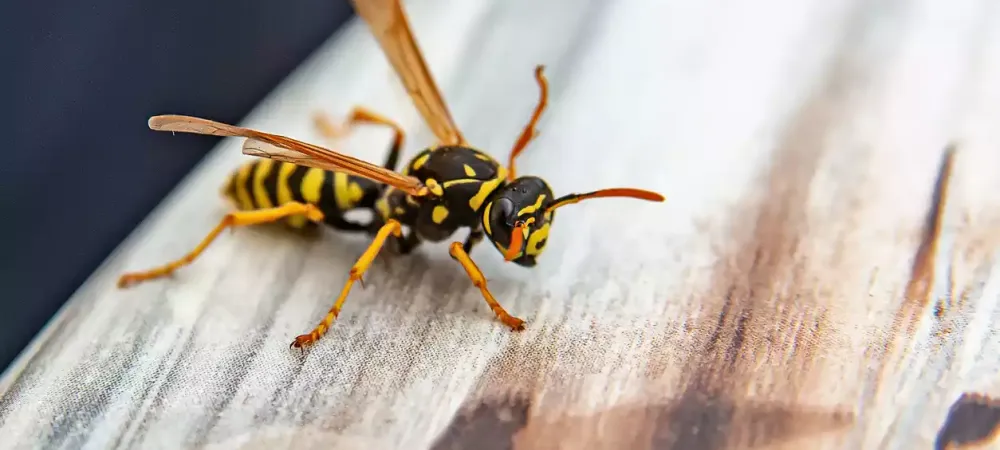
Why Are There So Many Wasps Around My House?
Wasps gather around homes in late summer and early fall because their colonies have reached peak size for the year and new queens are leaving the nest to find a place to spend winter. This is not a sign that something is wrong with your home. It is the normal life cycle of a wasp colony reaching its busiest point right before it ends.
What Kind of Wasp Is Actually Around Your House
The wasp buzzing around your porch in 2026 is most likely one of three species common across Iowa and Nebraska. Paper wasps are slender with long legs and build open, umbrella-shaped nests under eaves, deck rails, or window frames. Yellowjackets are shorter and stockier with bold black and yellow bands, and they often nest in the ground or inside wall voids. Bald-faced hornets are black and white, build large enclosed papery nests in trees or on the sides of structures, and are the most defensive of the three if their nest is disturbed.
Knowing which type you have matters because each one responds to different removal methods. A paper wasp nest with a dozen wasps is a very different job than a yellowjacket nest with hundreds of workers underground.
Why They Keep Showing Up in the Same Spot
Wasps do not return to the same corner of your house because of food left outside the way ants do. A nest, once started, anchors the entire colony to that location for the rest of the season. South- and west-facing areas that get afternoon sun are common nesting spots because the warmth helps the colony develop faster. Small gaps under siding, in soffits, or around utility lines give the queen a protected starting point in spring that grows into the nest you are noticing months later.
This is a common point of confusion: people assume wasps are attracted to something they are doing, like grilling or leaving out sugary drinks. Yellowjackets will scavenge for food in late summer when their colony's nutritional needs shift, but the nest location itself was almost always chosen back in spring, long before any cookouts happened. Once you know why they're showing up, the next step is keeping them out; see our guide on how to keep wasps and bees away.
Are These Wasps Actually Dangerous
Most wasp encounters result in pain and swelling at the sting site that fades within a day or two. The real risk is for the estimated 1.6% to 5.1% of people who have experienced a life-threatening allergic reaction to an insect sting, according to the American College of Allergy, Asthma & Immunology. For that group, a sting can trigger a severe reaction requiring emergency care. Bald-faced hornets and yellowjackets are more likely to sting multiple times and defend their nest aggressively if it is bumped or vibrated, while paper wasps are generally calmer unless someone reaches directly into their nest.
Anyone in the household with a known sting allergy, or anyone stung who develops swelling beyond the sting site, difficulty breathing, or dizziness, should seek medical attention right away.
Why DIY Removal Often Backfires
Spraying a visible nest with store-bought aerosol can work for a small, exposed paper wasp nest with only a few wasps present. It becomes a real problem with yellowjackets, because their nests are often underground or inside a wall void with an entrance far from the visible activity. Spraying the wrong spot agitates the colony without killing the nest, which is how people end up with dozens of angry wasps and no resolution.
Midwest Pest Control identifies the actual nest location and species before treating, which is the difference between a one-time spray that makes things worse and a treatment that removes the colony. Wasp and stinging insect treatment is included as part of our residential pest control service.
Dealing with wasps building up around your home, or not sure what you're looking at? Call Midwest Pest Control at 402-524-5200, and we'll help you figure out the right next step.