
Why Am I Suddenly Seeing So Many Spiders in My House?
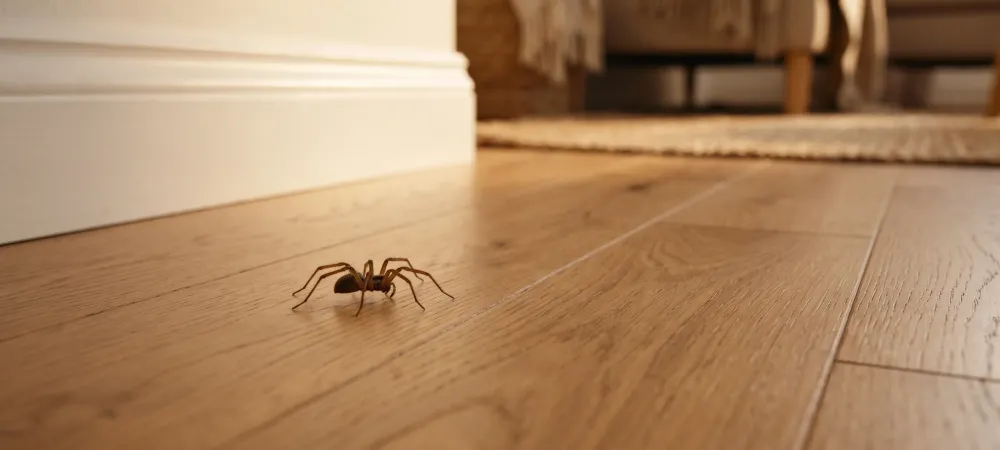
The spiders showing up in your hallway in September are not new arrivals escaping the cold. Most of them have been living in your house for months. What changed is that mature male spiders have left their webs to look for mates, which puts them out in the open, crossing floors and walls where you finally notice them. The population did not spike. The visibility did.
Spiders do not come inside to escape the cold
Spiders are cold-blooded, so warmth holds no appeal for them. According to the arachnology program at the Burke Museum, spiders do not shiver or grow uncomfortable as temperatures drop. They simply slow down and eventually go dormant. A spider has no reason to seek out your furnace.
The more useful correction is where house spiders come from. Fewer than 5% of the spiders you see indoors have ever been outside. The common house spiders in Nebraska and Iowa homes belong to a small group of species adapted specifically to indoor conditions, meaning stable temperature, thin food supply, and very little water. Those species live and breed inside. Yard and garden spiders are a different set of species entirely, and they are poorly suited to life indoors.
That matters because it changes what you should do about it. If most of the spiders in your home were born there, then sealing your foundation is not the fix people assume it is.
What is actually happening in late summer and early fall
Male spiders reach maturity in late summer and abandon their webs permanently to search for females. Across Nebraska and Iowa, this wandering peaks from late August through September, which is exactly when homeowners start calling. The males follow chemical trails left by females, and that search involves a lot of aimless roaming. It is why the spider you find is usually alone, usually large, usually long-legged, and usually moving fast across an open floor at night.
Females and juveniles do not do this. They stay put in wall voids, crawl spaces, basement corners, storage rooms, and behind appliances. You are seeing a specific and temporary slice of the population, and the males die off as the season closes out.
| What it looks like | What is actually happening |
|---|---|
| Spiders are pouring in from outside | Most were already living inside, out of sight |
| They want the warmth of the house | Spiders are cold-blooded and indifferent to heat |
| The population suddenly exploded | Mature males left their webs and became visible |
| One spider means an infestation | A lone wandering male is normal for September |
| It will get worse all winter | Male activity drops off sharply by late fall |
Why sealing your house will not stop spiders the way it stops mice
Sealing entry points is the single most effective thing you can do about mice, because every mouse in your house came in from outside through a specific gap. Spiders are the opposite case. Since the majority of house spiders were born indoors and complete their entire life cycle there, closing gaps does not remove a population that is already established inside the walls.
Sealing still helps at the margins. Wandering outdoor species like wolf spiders do come in through gaps under doors, around utility penetrations, and through unscreened vents, and tightening those openings cuts down on the accidental visitors. Iowa State University Extension groups spiders with other accidental invaders and recommends tight-fitting doors and windows, sealed openings around pipes and wires, and screens kept in good repair. Do that work. Just do not expect it to solve a spider problem the way it solves a rodent problem. If you want the entry point list, our post on common rodent entry points covers the same openings in detail.
The fastest way to reduce spiders is to reduce what they eat
Spiders stay where the food is. A house with a heavy spider presence almost always has a heavy insect presence feeding it, which means the spiders are a symptom rather than the root problem. Cut the prey and the spider population follows within weeks, because there is nothing left to hold them.
- Change your outdoor lighting. Porch and garage lights pull in moths, flies, midges, and gnats, and the spiders set up where that food lands. Switching to warm-toned or yellow bulbs, or moving the fixture away from the door, cuts the insect draw significantly.
- Clear the foundation line. Mulch beds, leaf litter, stacked firewood, and shrubs pressed against siding hold moisture and insects right where spiders can reach the house.
- Stay on a regular pest control program. Ongoing residential pest control suppresses the ants, flies, and occasional invaders that spiders feed on. This is the part homeowners skip, and it is why one-off spider sprays tend to disappoint. Killing the spiders you can see does nothing about the food supply that produced them.
Which spiders in Nebraska and Iowa deserve a closer look
Most spiders in Nebraska and Iowa homes are harmless, and the overwhelming majority of what you find crossing a basement floor falls into that group. Two species do warrant identification rather than a guess, and misidentification runs heavily in one direction. Homeowners routinely label any small brown spider a brown recluse when it is far more often a funnel weaver or a young wolf spider.
If you want to know what you are actually looking at, our guide to common spiders in Nebraska walks through the species you are most likely to encounter and how to tell them apart. Identify before you react.
When the activity is worth a call
Daily sightings in living space, webbing that returns within days of being cleared, or egg sacs in basement and garage corners all point to an established indoor population rather than seasonal wandering. A confirmed medically significant spider in a home with kids or pets is also worth a professional inspection rather than a wait-and-see.
Seeing one large spider cross the floor in September is not a reason to worry. Seeing several a week in the same room is a reason to look at what is feeding them.
Not sure what you are looking at, or seeing more than feels normal for the season? Call Midwest Pest Control and we will take a look and tell you straight whether it needs treatment.
Call 402-524-5200Sources
Burke Museum, Spider Myths: Spiders Come Indoors in the Fall — https://www.burkemuseum.org/collections-and-research/biology/arachnology-and-entomology/spider-myths/myth-spiders-come-indoors
Iowa State University Extension, Household Accidental Invaders — https://hortnews.extension.iastate.edu/1999/8-27-1999/invaders.html