
Where Do Ticks Come From in Iowa and Nebraska Yards?
Ticks come from tall grass, leaf litter, and brushy edges where a yard meets woods, fence lines, or untrimmed landscaping. They are not concentrated in deep forest the way many homeowners assume, and a well-kept lawn is rarely where the real population lives. The edges and transition zones around a property are where ticks wait for a host to walk by.
Ticks Wait, They Do Not Jump or Fly
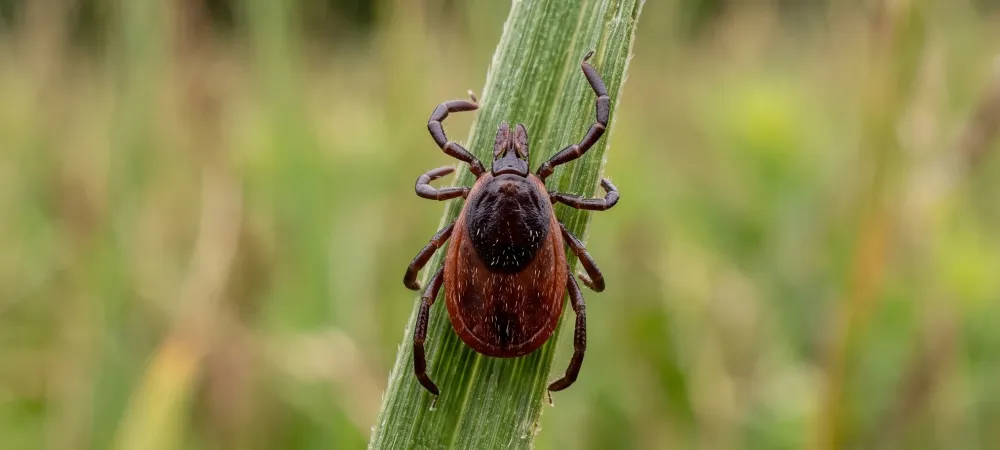
A common myth is that ticks drop out of trees or jump onto people the way fleas do. Ticks cannot jump or fly. Instead, they climb to the tip of grass blades or low shrubs and hold their front legs out in a behavior called questing, waiting for a person, pet, or animal to brush against the vegetation. This is why the actual contact points in a yard are the edges, not the open lawn: tall grass borders, brush piles, stone walls, and the shaded perimeter where a mowed yard meets unmaintained growth.
Which Ticks Show Up in Iowa and Nebraska
The blacklegged tick, also called the deer tick, is the species that matters most in this region because it can transmit Lyme disease. Iowa State University Extension and Outreach and the Nebraska Department of Health and Human Services both identify the blacklegged tick as present throughout their states and expanding in range, with eastern Iowa carrying the highest concentration. The American dog tick is also common and is larger and easier to spot, but it is not considered a significant Lyme disease risk in this region.
Adult blacklegged ticks are roughly the size of a sesame seed, while the nymph stage that emerges in late spring is closer to the size of a poppy seed, which makes the nymph stage the hardest to spot before it has already attached. Lyme disease transmission generally requires the tick to remain attached for at least 36 hours, with risk increasing the longer it stays attached, according to Iowa State University Extension and Outreach.
Tick Season Runs Longer Than Most People Expect
Tick activity in Iowa and Nebraska follows two peaks rather than one continuous season. Blacklegged tick nymphs are most active from May through July, while adult blacklegged ticks have a second peak in fall that continues into November on mild days. Adult blacklegged ticks can become active any day temperatures climb into the mid-40s, which sometimes starts as early as March, well before most homeowners start thinking about ticks at all.
What Actually Reduces Ticks in a Yard
Mowing alone helps but does not solve a tick problem, because it removes the tall grass questing spots in the open lawn while leaving the brushy edges, leaf litter, and shaded perimeter untouched. A barrier treatment applied to the actual edge habitat, combined with clearing leaf litter and trimming back brush along fence lines and tree lines, addresses the areas where ticks are actually present rather than the areas where they are rarely found.
Midwest Pest Control targets these edge zones directly during yard treatments, since treating the open lawn and skipping the perimeter is the most common reason a tick problem does not improve. Tick treatment is included in our Home Defense Plus Yard plan, which covers outdoor pests at the perimeter of your property.
Dealing with ticks in your yard, or finding one on a pet or family member, and are not sure what to do next? Call Midwest Pest Control at 402-524-5200, and we'll help you figure out the right next step.